Creating national standards to approve kin caregivers
Co-designed national foster home licensing standards in the U.S. and built template forms, to help keep children with family members.
The challenge
Children who are removed from their parents have better outcomes when placed with kin caregivers. Kin caregivers are family members or friends that children already have a connection with. Unfortunately, kin often face barriers to getting approved as licensed caregivers, which restricts their access to resources and financial support to care for the child.
In 2023, a federal rule change opened the door to build dedicated standards for licensing kin. The goal of this project was to research and provide guidance to child welfare agencies across the U.S. on how to assess kin caregivers and support them throughout the licensing process.
Improving background checks
This work started with a 7 week study. I was one of two user experience researchers (UXRs) running a project on understanding background checks for kin caregivers. We held interviews with 45 state and tribal child welfare agencies.
During this project I spoke with subject matter experts and kin caregivers, and analyzed qualitative and quantitative data from state agencies on their background check process. This led to the development of a current state and ideal state process map to streamline and shorten the process.
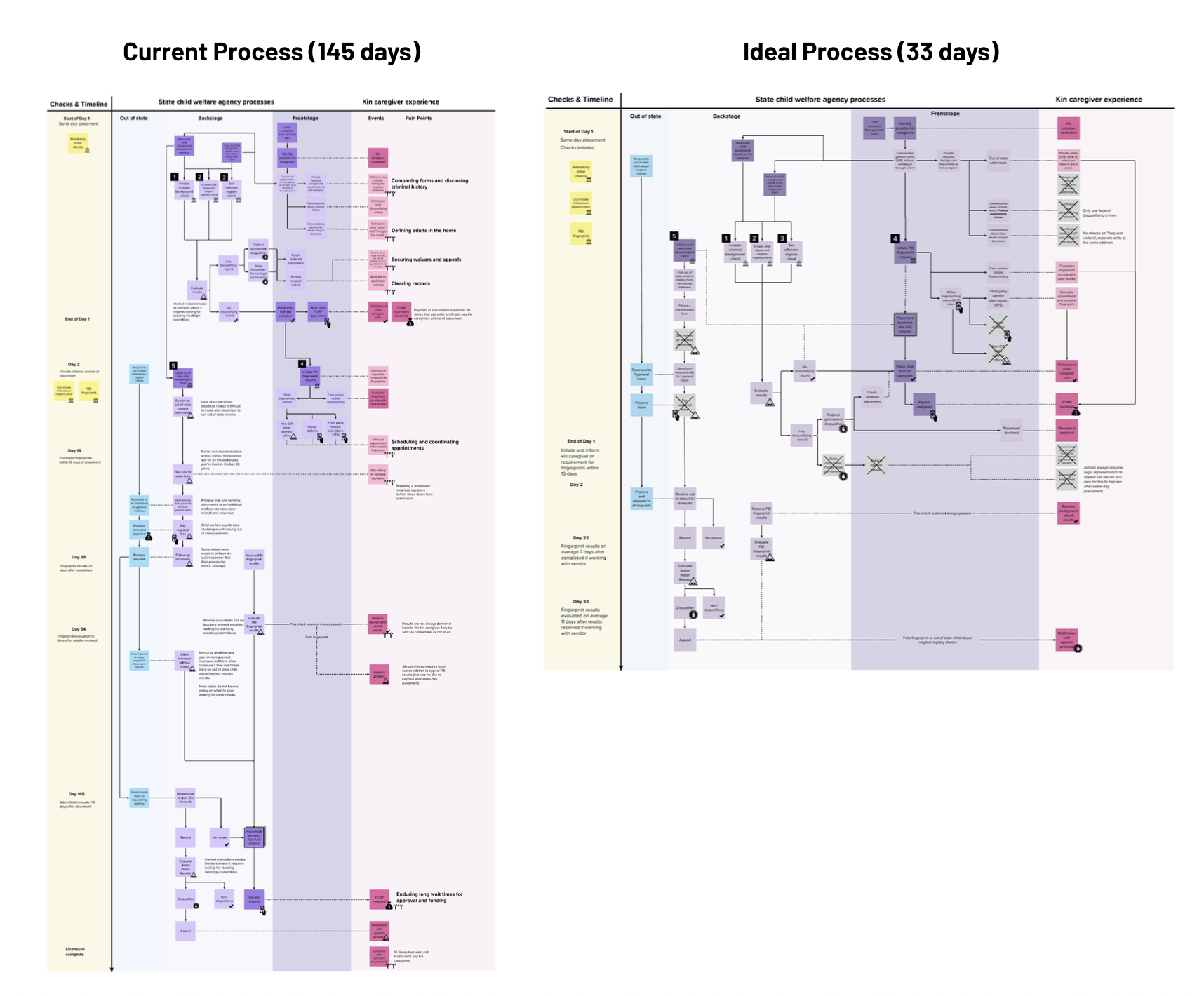
Pain points we found
We heard from kin caregivers that they faced a number of challenges to completing background checks:
- Completing forms and disclosing criminal history: It’s unclear what crimes are disqualifying.
- Defining adults living in the home: There’s confusion over visitors and at what age someone needs a background check.
- Securing waivers and appeals: Needing to appeal a background check prolongs time to placement and risk of harm if the child is moved multiple times.
- Clearing records: Clearing non-criminal Child Protective Services records has many administrative hurdles.
- Scheduling and coordinating appointments: Multiple checks are required and there is limited availability of fingerprinting sites.
- Enduring long wait times for approval and funding: Waiting for results delays funding for unplanned caregiving expenses.
Developing kin caregiver assessments
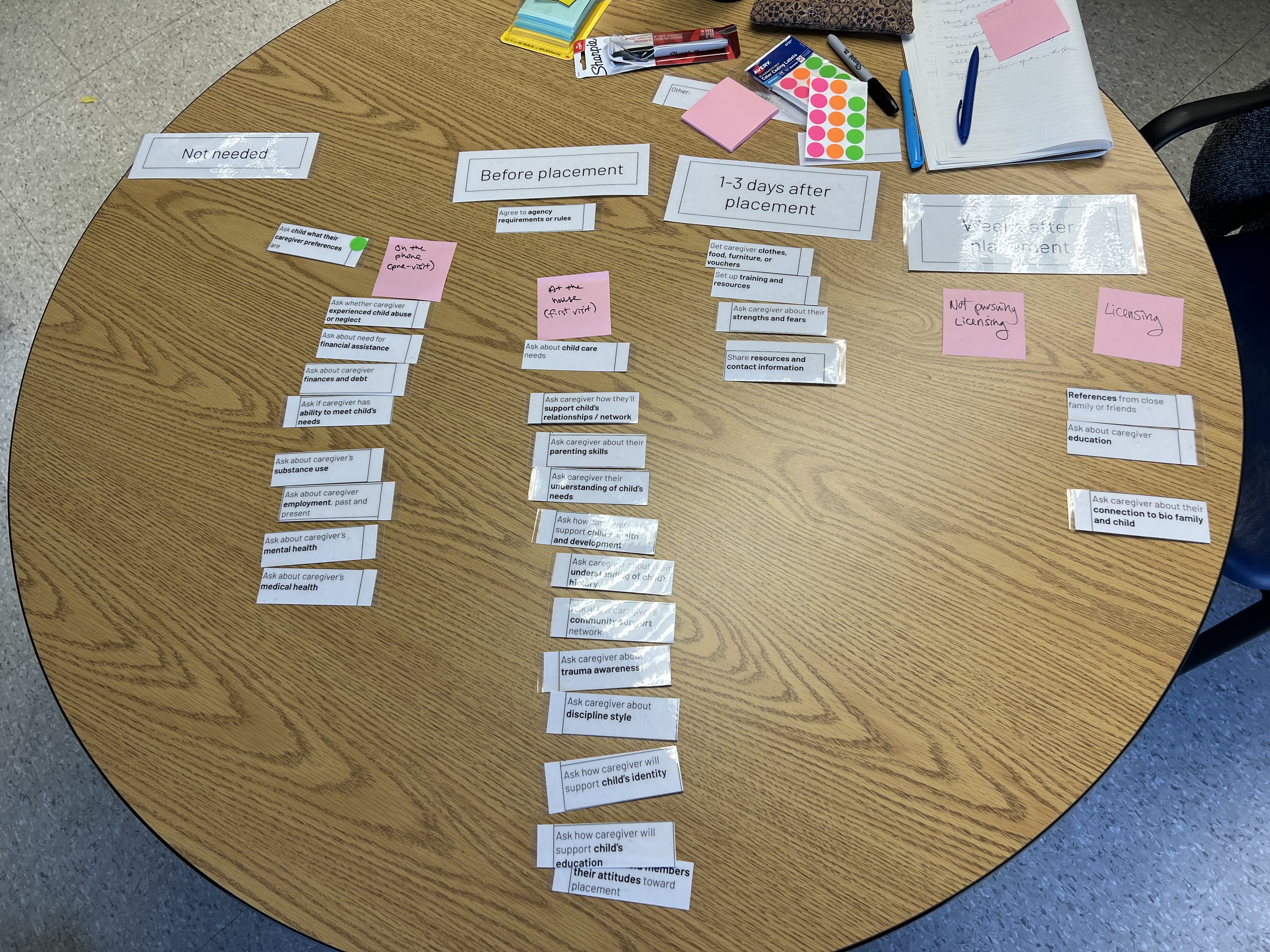
I rejoined the project in the final 6 months as one of three UXRs with the goal of understanding how to assess kin caregiver and support them through the licensing process. I co-developed and iterated on the research plan, conducted desk research, recruited participants, moderated 1:1 interviews, facilitated co-design sessions and workshops with staff, and conducted user testing. This included planning and running in-person research observations with a state child welfare agency.
This project resulted in a set of tested template forms for state agencies to use when assessing caregivers, a staff training guide and how to use it, and an annotated form explaining questions we removed.
Impact
This work has resulted in saving money, time, and stress for families as well as child welfare agencies. As we released early designs and versions of the form, many states were quick to start adapting and think about how to use the new templates and standards as they developed a separate process to approve kin caregivers.
As of April 2026, 20 states and 6 tribes have approved plans to create a kin-specific licensing process. In 2025, the project won a Service Design Award, which I initiated the submission and application process for.
"This project demonstrates what's possible when design is used as an instrument of justice, not just efficiency." Eliisa Sarkkinen, Service Design Award judge
Reflections
When working on background checks, talking with people who'd designed background checks in sectors outside child welfare gave us context on limitations and promising practices we wouldn't have found by staying inside the field. A survey we ran received many automated bot responses, which required cleaning the data. To mitigate against that, we built captchas and individual tracking links into future projects.
In the later project on the development kin assessments, we struggled to get through initial testing sessions in a meaningful way. This led us to pivot our research approach, and to instead conduct 3 rounds of testing in order to get meaningful feedback, iterate, and validate updates through additional rounds of testing.